
Projected Date vs Actual Release
A projected release date is a planning or calculation date. It is not the same as the moment someone walks out of Hill Road Correctional Facility, leaves a CDCR prison, or transfers into another agency's custody. A pretrial detainee may have no set date at all. Release can occur after bail is posted, an own-recognizance order is entered, charges are dismissed, a time-served sentence is applied, another hold is cleared, or court papers reach the jail.
Lake County's Inmate Release page explains some of the local timing. Booking can take several hours, intoxicated arrestees remain until sober and sometimes 12 hours or more, and people released by court are released as soon as possible after they return from court. It also states that information about transportation to state prison or another institution will not be released.
How to Find the Release Date
Start with the system that actually controls the person. The public Lake County current-custody path answers whether a person is still in Hill Road custody. The court case explains bail, sentence, custody credits, remand, dismissal, probation, or transfer. CDCR CIRIS is for current state prison custody, not for every Lake County jail release. BPH records matter only for parole-suitability cases.
- Check the Lake County current-custody path from the official In Custody page and Citizen RIMS to see whether the person is still listed.
- Use the Lake County Superior Court case search for sentence, credits, release terms, transfer orders, or future hearings.
- For a county jail sentence, ask Hill Road Correctional Facility or the Sheriff's Records Unit for disclosable booking and release information if the online record no longer answers the question.
- For a state prison sentence, search CDCR CIRIS and compare name, CDCR number, age, commitment county, admission date, current location, and any BPH fields.
- If CIRIS is inconclusive, use CDCR's Identification Unit at 916-445-6713, Monday through Friday except holidays, 8:00 a.m. to 4:30 p.m. Pacific.
- For a parole-suitability case, check BPH schedules and results, then remember that a proposed grant generally has final review steps before physical release.
The official CA.gov description of CIRIS is useful because it describes the public state search fields for people currently in CDCR custody.
For Lake County readers, the key limit is the word current. A missing CIRIS result should not be treated as proof of discharge, release, or no CDCR history. Confirm with the court case, CDCR Identification Unit, parole or PRCS agency, and VINE if the person was registered for notification.
Lake County Jail Credit Factors
County jail release-date calculations can depend on the sentence, actual time already served, presentence credits, conduct credits, loss or restoration of credits, other holds, alternative custody, and processing of court paperwork. Penal Code section 4019 is the starting statute for good-time and work-time deductions in specified local custody categories. Penal Code section 2900.5 provides credit for time spent in custody, including jail and several other residential custody settings, against the term of imprisonment or certain fines.
Lake County's custody rule book adds a local hook. It lists loss of good time/work time and says inmates may earn good time/work time back with good behavior if conditions are met, including nonviolence, no threats to safety or security, 30 days or more without write-ups, willingness to perform extra work duties, and discretion of the Facility Commander or designee. It also lists "Release Dates" as a Housing Deputy contact and "County Parole Applications" as an Inmate Service Deputy contact.
| Factor | How It Can Affect a Date |
|---|---|
| Presentence custody credit | May reduce the remaining sentence if the court awards credit under California law. |
| Good-time/work-time credit | Can move a county jail sentence date earlier, subject to eligibility and discipline. |
| Credit loss or restoration | Discipline can change a date; Lake County's rule book describes conditions for earning lost time back. |
| Other holds or warrants | A person may finish one sentence but remain held or transfer on another agency's authority. |
| Court paperwork | The jail or CDCR may need the abstract, minute order, or release order before final processing. |
Accelerated County Release Caveat
Penal Code section 4024.1 allows accelerated release, discharge, or sentence-expiration changes for sentenced county or city jail inmates when a court authorizes it and actual inmate count exceeds actual bed capacity. The statute includes limits, including up to 30 days and a cap of 10 percent of the original sentence before other credits or benefits. For Lake County, this should be described as a possible statutory mechanism, not as a routine current policy, unless the county or court confirms a specific authorization.
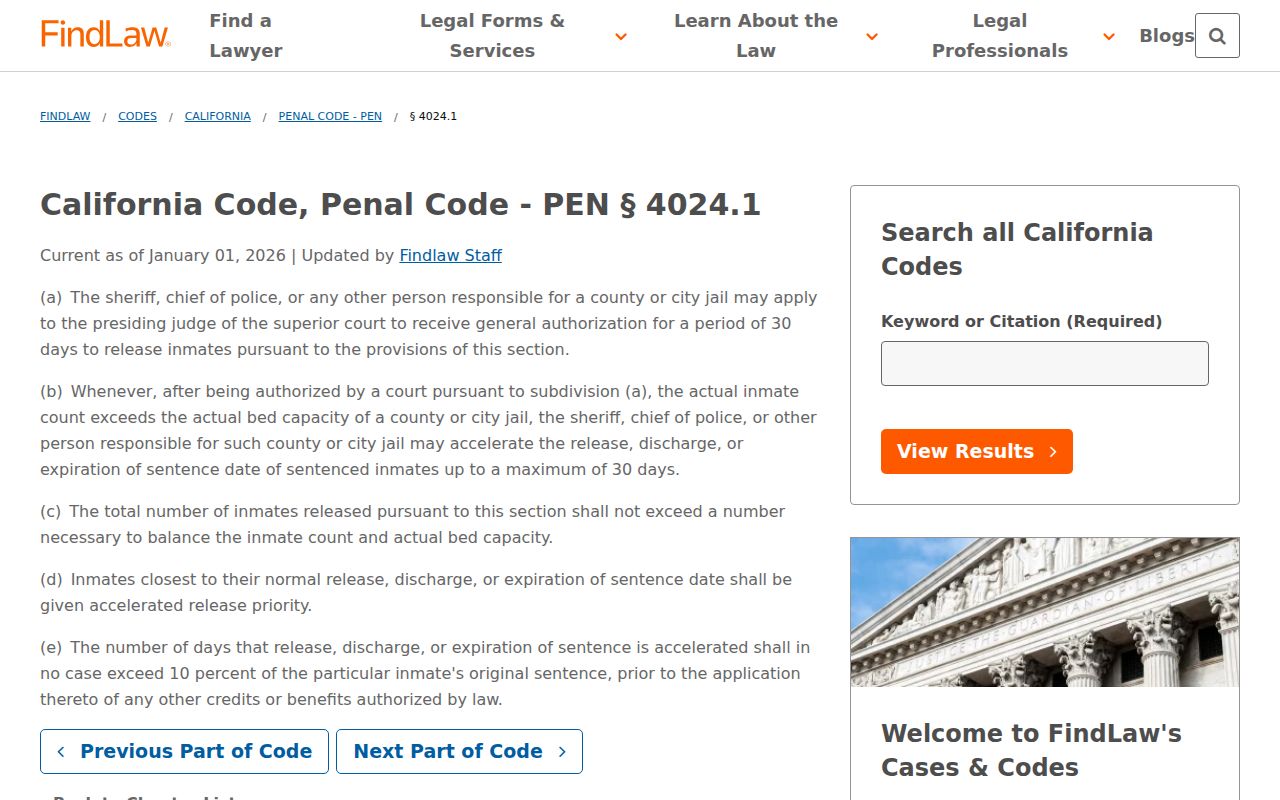
That caveat matters because release-date math is not only arithmetic. The controlling source is the actual sentence, court order, jail calculation, and any lawful release authority in effect for the person.
CDCR and CIRIS Release Dates
For a person sentenced from Lake County to state prison, CDCR is the state agency. CIRIS is the public search starting point, but the CA.gov service description is current-custody oriented. If a CIRIS record displays a projected, tentative, earliest possible, parole eligible, or similar field, treat the label exactly as shown and do not convert it into proof of actual release. Credits, discipline, resentencing, parole eligibility, court orders, statutory changes, and administrative processing can all change the date.
CDCR's release-processing source explains why court action and physical release may not be simultaneous. CDCR processes court abstracts and minute orders for release while complying with legal mandates, and its research source cites Penal Code section 1213 requiring courts to transmit documents forthwith. When the public state search is unclear, contact CDCR Identification Unit and compare the CDCR record to the Lake County court disposition.
The Identification Unit is the safer public fallback when the state-prison record is missing, appears stale, or lacks a release-detail field.
BPH Cases Without a Fixed Date
For parole-eligible life or similar CDCR cases, the projected date question may turn into a parole-hearing question. The BPH parole-eligibility page explains that people sentenced to state prison may become eligible for parole consideration or release based on one or more parole-eligible dates. Schedules list hearing dates and formats, and results list recent proceedings by week. A proposed grant does not mean immediate physical release. BPH says decisions generally become final within 120 days unless reviewed, referred, or otherwise changed.
Use BPH results to understand the parole-suitability step, then confirm final status with CDCR, the supervising parole or PRCS agency, VINE registration if available, and the Lake County court record if the original case is needed for identification.
Confirming the Actual Release
California VINE can send custody-change alerts for participating county jail and state custody workflows, especially when registration happens before the release or transfer. Use VINELink Check for notification, but do not rely on VINE alone as a complete historical archive. For a formal Lake County release record, ask the Sheriff's Records Unit for disclosable booking and release information, including time and manner of release. Government Code section 7923.610 specifically names time and manner of release among public arrest information, subject to safety and investigation limits.
When the question is "when will they be released," the most accurate answer is often a chain rather than one screen: current custody, court sentence and credits, jail or CDCR calculation, VINE notification, and then a release record after the fact.